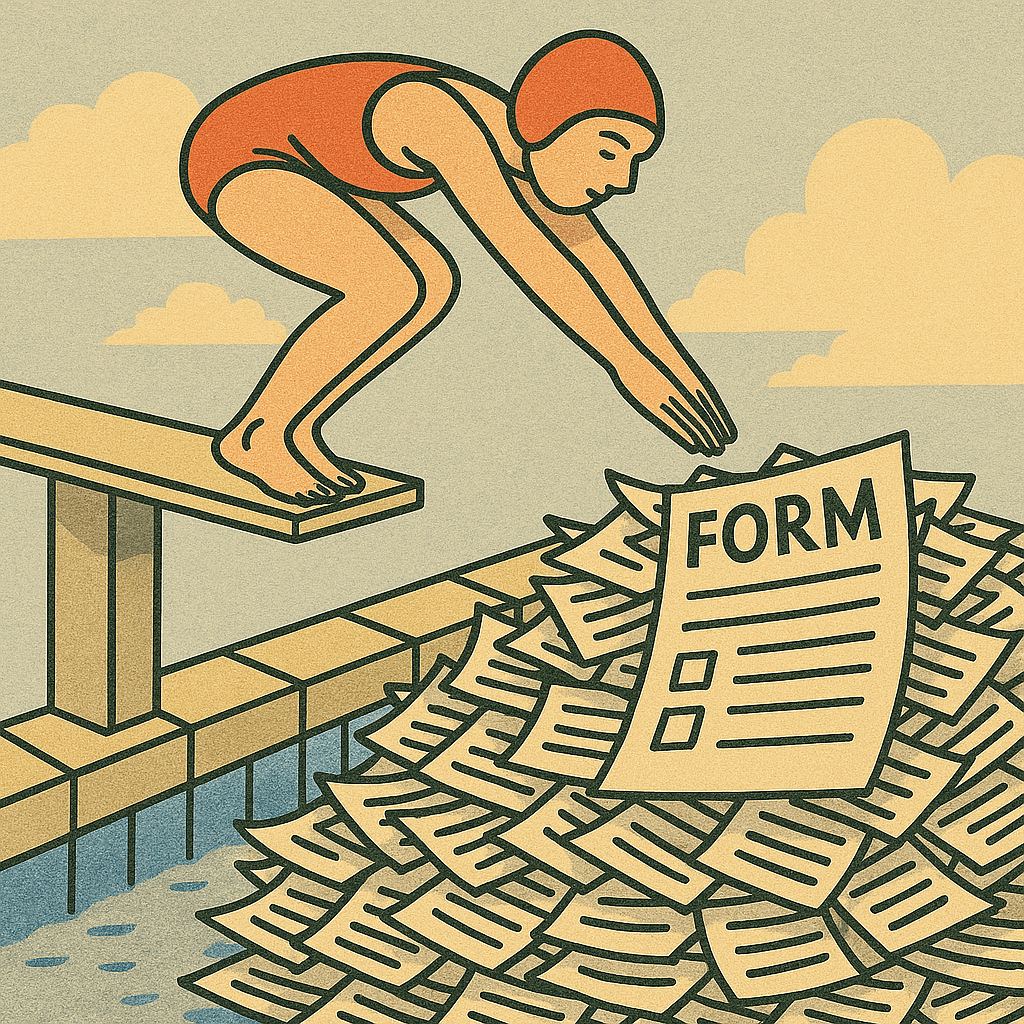
There is a particular kind of blindness that creeps into modern service organizations.
It’s not the dramatic kind that topples systems or sparks viral scandals.
It’s subtler.
It’s the quiet, cumulative failure to notice what’s right in front of us.
You see it in the way teams obsess over journeys and touchpoints, obsessively map “ecosystems” onto pristine whiteboards, and wax lyrical about user delight. There is no shortage of frameworks or rituals. But through all this theatre of service design, most people fail to see one thing:
The form.
It sits there, perfectly ordinary.
Waiting.
Not glamorous enough to feature in strategy decks.
Not complex enough to be hailed as a system.
Not visual enough to excite product demos.
And yet, forms are everywhere.
- Filing an insurance claim? Form.
- Registering for healthcare? Form.
- Submitting expenses? Form.
- Cancelling a subscription? Form.
- Booking a doctor’s appointment? Form.
- Applying for a visa? Form.
- Reporting a damaged parcel? Form.
- Updating a shipping address? Form.
- Uploading ID verification? Form.
- Requesting sick leave? Form.
- Reporting a data breach? Form.
- Filing a building permit? Form.
Once you begin to notice them, they are as ubiquitous as the kerning in the interface — woven into every interaction that demands something from the user.
Every form is a quiet transaction:
“You give us information; we give you progress.”
The hidden tension behind every question
Some forms negotiate minor stakes.
“How old are you?” (To verify you can buy a bottle of wine.)
Others sit beneath weightier scenarios.
“Do you have food allergies?” (To avoid sending you into anaphylactic shock.)
Others serve bureaucratic obligations.
“Enter your full legal name as shown on your passport.” (So the airline can issue a valid ticket.)
At their most functional, forms collect exactly what is needed, at the precise moment it’s required.
At their worst, they calcify. They inherit fields nobody remembers justifying. They sprout questions added under the vague excuse of “it might be useful one day.” They accumulate like sediment.
Few things generate more operational cost, user frustration, or privacy risk than forms allowed to bloat quietly over time.
Ironically, most bad forms aren’t designed with malice.
They are designed passively — by legacy, by inertia, by the quiet pull of institutional habit
The quiet craft
True service design treats forms not as afterthoughts, but as precise tools of choreography.
- Every unnecessary question is friction.
- Every field you add is a minor tax on trust.
- Every piece of data you collect becomes a liability.
This is why services like Monzo, Revolut, or Estonia’s e-government feel so startlingly different.
It isn’t simply because the interface is pretty or the copy is friendly (though they are).
It’s because they interrogated each field:
“Do we really need this?”
They resisted the gravitational pull of legacy systems that treat user input as an infinite resource. They recognized that brevity is not just a user experience virtue — it’s a system design strategy.
The result: onboarding flows that once consumed hours or days are now dispatched in minutes.
This isn’t about aesthetics. It’s operational clarity.
The Form Protocol
To avoid the slow rot of form bloat, teams need something more robust than intuition.
The Form Protocol is a quiet discipline applied before any form is built — or, more challengingly, when old ones are reconsidered.
It demands that every field earns its place.
| Protocol Question | Purpose |
|---|---|
| 1. Do we need this information to deliver the service? | If not essential, it has no right to exist. |
| 2. Why do we need it? | Forces specificity — legal, operational, or user value. Vague answers are red flags. |
| 3. What will we do with it? | Prevents collecting “just in case” data. Clarifies downstream use. |
| 4. Are there other ways to get this information? | Pushes toward reuse, prefill, and system integration. Avoids redundant questions. |
| 5. How hard is it for the user to answer this? | Surfaces cognitive load. Demands design empathy around answerability. |
| 6. Is this the right moment to ask for this? | Drives sequencing. Some data may be better collected later. |
| 7. What happens if the user cannot provide this? | Forces contingency planning, accessibility, and service resilience. |
| 8. How will we check its accuracy? | Prevents unverifiable or unreliable data collection. Quality in, quality out. |
An example: Submitting an insurance claim
Imagine you’ve just experienced the minor misfortune of damaging your car. You open your insurer’s app to file a claim.
Field: Policy Number
| Protocol Question | Assessment |
|---|---|
| Do we need this? | Technically yes — identifies the policy. |
| Why? | Ties claim to correct customer account. |
| What will we do with it? | Pull policy details, validate coverage. |
| Other ways to get it? | Customer is logged in; can retrieve automatically. |
| User burden? | High, if user has to manually find policy number. |
| Right moment? | System should already have it. |
| What if user can’t provide? | Creates avoidable frustration. |
| Accuracy? | Guaranteed if pulled from account. |
🚫 Remove manual entry. Prefill via system context.
Field: Date of Incident
| Protocol Question | Assessment |
|---|---|
| Do we need this? | Yes. |
| Why? | Determines coverage eligibility. |
| What will we do with it? | Validate claim falls within policy period. |
| Other ways to get it? | Could suggest recent dates based on telematics or incident reports, but user confirmation still needed. |
| User burden? | Moderate. |
| Right moment? | Yes — essential claim input. |
| What if user can’t recall? | Offer approximate date range selector. |
| Accuracy? | Subject to user memory. Could be cross-checked with police reports or GPS data if applicable. |
✅ Keep — but design for fuzzy inputs.
Field: Upload Photos of Damage
| Protocol Question | Assessment |
|---|---|
| Do we need this? | Yes — supports claim assessment. |
| Why? | Visual evidence for assessors. |
| What will we do with it? | Document condition, estimate repairs, verify claim legitimacy. |
| Other ways to get it? | No substitute for visual proof. |
| User burden? | Medium — but intuitive via smartphone cameras. |
| Right moment? | Yes — immediately post-incident. |
| What if user can’t provide? | Allow delayed submission. |
| Accuracy? | Visual — subject to assessor judgment. |
✅ Keep — but allow staged submission.
The result
Through the protocol, what begins as a bloated insurance claim form collapses into a sharply tuned dialogue with the user.
Only essential fields remain.
System context reduces unnecessary inputs.
User cognitive load drops.
Backend complexity shrinks.
And crucially: user trust grows.
The quiet dividend of good forms
There is a hidden dividend that emerges once forms are treated with this discipline.
You stop sitting on bloated, noisy datasets full of redundant or unreliable fields.
Instead, you begin to build a clean, functional data corpus:
- Every field serves a defensible purpose.
- Data pipelines become simpler to maintain.
- Connecting behavioral data to account records becomes more meaningful.
- Personalisation engines work with lean, trustworthy inputs.
- Compliance audits become cleaner and faster.
- Privacy exposure is minimized.
You move from hungry, indiscriminate data collection to functional data harvesting — where every data point has utility, traceability, and integrity.
In a world obsessed with “big data,” this discipline offers something rarer: good data.
An invitation
This is how I approach form audits.
But design, like forms themselves, is iterative by nature.
How do you approach form design in your organization?
Do you apply protocols of your own?
Where do you see form bloat creeping in?
I’d love to hear how others tackle this quiet but consequential craft.
Drop me a note. Let’s compare notes. The smallest questions often lead to the most interesting conversations.
 Amogh's Field Manual