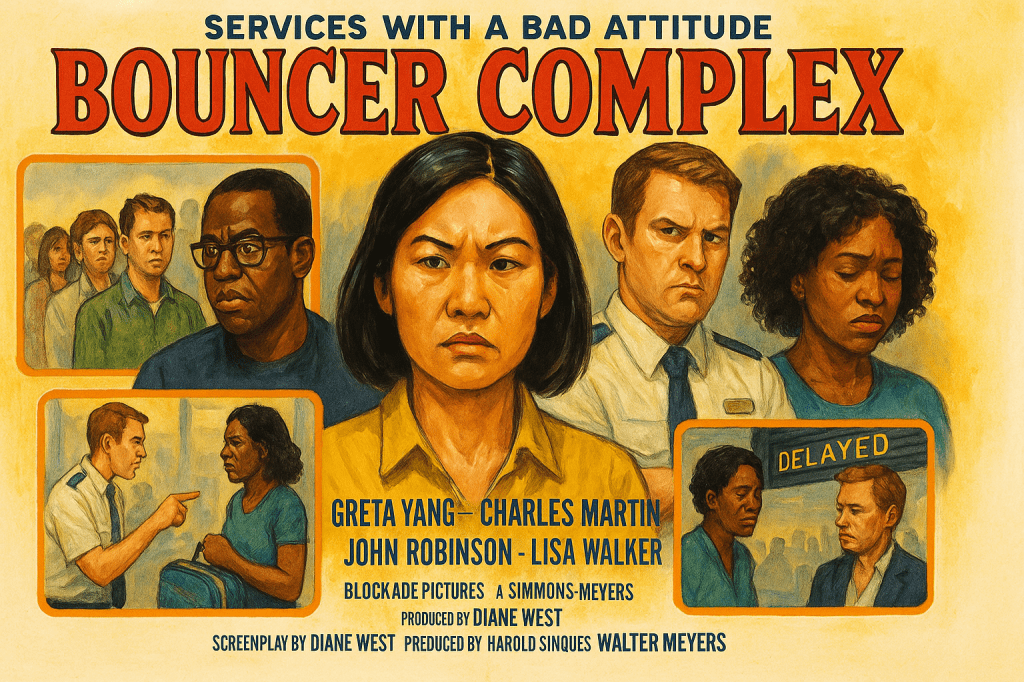
You wake up early—real early. You skip breakfast, skip your dignity, skip any illusion that this day will go smoothly. You’re flying economy, after all. A phrase that now sounds less like a class of ticket and more like a cautionary tale.
You open the airline app. It spins. Crashes. Tries to gaslight you with a “Something went wrong.” So you drag yourself to the terminal, where the self-check kiosks blink like dead-eyed slot machines. No dice. And now, here you are—herded into a queue that snakes past two broken printers, a stressed-out family of six, and a couple arguing about boarding zones like it’s a hostage negotiation.
You wait. You wait some more. And when you finally arrive at the check-in desk—sweaty, sheepish, slightly broken—the agent looks at you like you’re the problem. No apology for the tech failure. No empathy for the 40-minute line. Just a sigh, a flat “you’re late,” and a passive-aggressive keystroke symphony.
Then comes the kicker.
Your carry-on? The one that’s made it onto every flight since the 2014 FIFA world cup? Suddenly, it’s 2 centimeters too tall. They make you wedge it into the metal cage like you’re trying to force a rhino into a wetsuit. It doesn’t fit. Now you owe £60. Card only. “Policy.”
You ask why. You know why. But you ask anyway.
The agent doesn’t look up. “It’s the rules.”
Security’s next. Shoes off. Belt off. Dignity off. You’re a suspect by default—water bottle? Threat. Slight limp? Secondary screening. Emotional damage? Irrelevant.
By the time you reach your gate, it’s delayed. Not by ten minutes. Not by thirty. Indefinitely. No reason. No compensation. Just a gate change two terminals away and a grim announcement mumbled through a speaker system last serviced in the Cold War.
And you realize: this isn’t bad service. It’s designed this way.
The tech that doesn’t work. The rules that shift. The punitive pricing. The indifferent staff. The dead-eyed enforcement of arbitrary lines.
Bouncer Complex (n.)
The “Bouncer Complex” in services refers to when gatekeepers—whether people, policies, or platforms—start behaving more like nightclub bouncers than enablers. Instead of facilitating access, they block, filter, or intimidate.
The Bouncer Complex occurs when a service or its frontline representatives take on a defensive posture—prioritizing control, suspicion, and exclusion over assistance, empathy, and inclusion. . It often manifests as rigid protocols, opaque decision-making, punitive defaults, and environments that make users feel unwelcome before they’ve even engaged.
Rooted in risk aversion and institutional defensiveness, the Bouncer Complex can erode service quality, marginalize vulnerable users, and undermine long-term trust.
👀 Symptoms
| Symptom | Example |
|---|---|
| Power hoarding | A receptionist who acts as a wall rather than a bridge—denying access without explanation. |
| Rigid protocols | Call center scripts that don’t allow deviation even when the customer’s issue doesn’t fit a neat box. |
| Trust erosion | Users are treated as potential abusers before they’re treated as customers. |
| Opaque logic | “Computer says no.” Systems give no insight into decision-making or rejection criteria. |
| Hostile environment cues | Warning signs, security cameras, ID demands—all before a service has been rendered. |
Why It Happens:
- Risk aversion: Designed to prevent fraud or misuse, but ends up punishing the 99% trying to do the right thing.
- Legacy culture: Services evolve from control-heavy bureaucracies (e.g., finance, immigration).
- Lack of design trust: Frontline staff are not trusted to make judgment calls, so rigid barriers are put in place.
Design against it!
| Design Principle | Anti-Bouncer Approach |
|---|---|
| Assume good intent | Make the default interaction feel trusting and helpful. Verify later if needed. |
| Build soft edges | Let people “peek in” to understand the process without committing upfront. |
| Design for escalation, not rejection | If an entry point doesn’t work, offer a graceful next step—don’t dead-end users. |
| Human override allowed | Empower staff to override rules with good reason. Trust trained judgment. |
| Transparent logic | Let users know why something was denied and how to fix it. |
Wait—What If the Bouncer’s Got a Point?
In defense of the Bouncer Complex (sort of).
Not all gatekeeping is bad. Sometimes, it’s the point.
Luxury brands have mastered the art of the velvet rope. The limited drop, the appointment-only showroom, the concierge who decides if you’re “on the list.” It’s exclusion as a feature, not a bug. Scarcity creates desire. Controlled access reinforces value. If anyone could walk in and buy a Birkin, it wouldn’t be a Birkin.
In competitive services—think academic fellowships, grants, elite sports, startup accelerators—gatekeeping isn’t just useful, it’s necessary. The process is the product. The filtering is the experience. A bouncer at the metaphorical door says: this isn’t for everyone, and in some cases, that’s exactly what gives it meaning.
Even in safety-critical environments, a soft-edged, all-access approach can be a disaster. You want nuclear plant protocols to feel like a Kafka novel. You want air traffic controllers to reject anyone who can’t navigate a maze of logic and stress tests
To Bounce or Not to Bounce
The Bouncer Complex isn’t inherently toxic. In the right context, it makes sense.
Elite competitions need filters. High-stakes environments need structure. Luxury brands trade in scarcity, and the velvet rope is part of the fantasy. We don’t want anyone walking off the street and into a nuclear facility, or copy-pasting their way into a surgical residency.
But that’s not where the Bouncer Complex lives.
It shows up in low-stakes, everyday services—places where friction isn’t necessary, just normalized. Think about:
- An airline that traps you in a non-functioning app, then blames you for not checking in.
- A government portal that demands three forms of ID to reset a password.
- A gym that lets you sign up in 30 seconds but requires a notarized letter and a phone call to cancel.
- A helpdesk that insists on treating your basic query like an adversarial legal proceeding.
These aren’t examples of thoughtful access control. They’re systems designed to make leaving, changing, or simply understanding a service feel like a test you didn’t study for.
What’s worse—they’re often automated. You’re not even dealing with a human bouncer anymore. Just a brittle logic tree with no room for nuance, and an FAQ that feels like it was written by someone who actively hates you.
And here’s the thing: Nobody thinks this is good design. Not the users. Not even the people who built it. It’s inertia. Risk-aversion. A legacy of assuming the worst in people, baked into the structure of services that should be humane and intuitive.
Gatekeeping is fine when the gate has a point. When it protects something.
But most services? They’ve just forgotten to open the gate.
A little synthesis with CGPT from forced ethnography exercises. Inspired by my many Vueling, Ryanair, Easyjet…. even Emirates and Qatar experiences over the last 5 years. Hope you enjoyed it 🙂
 Amogh's Field Manual