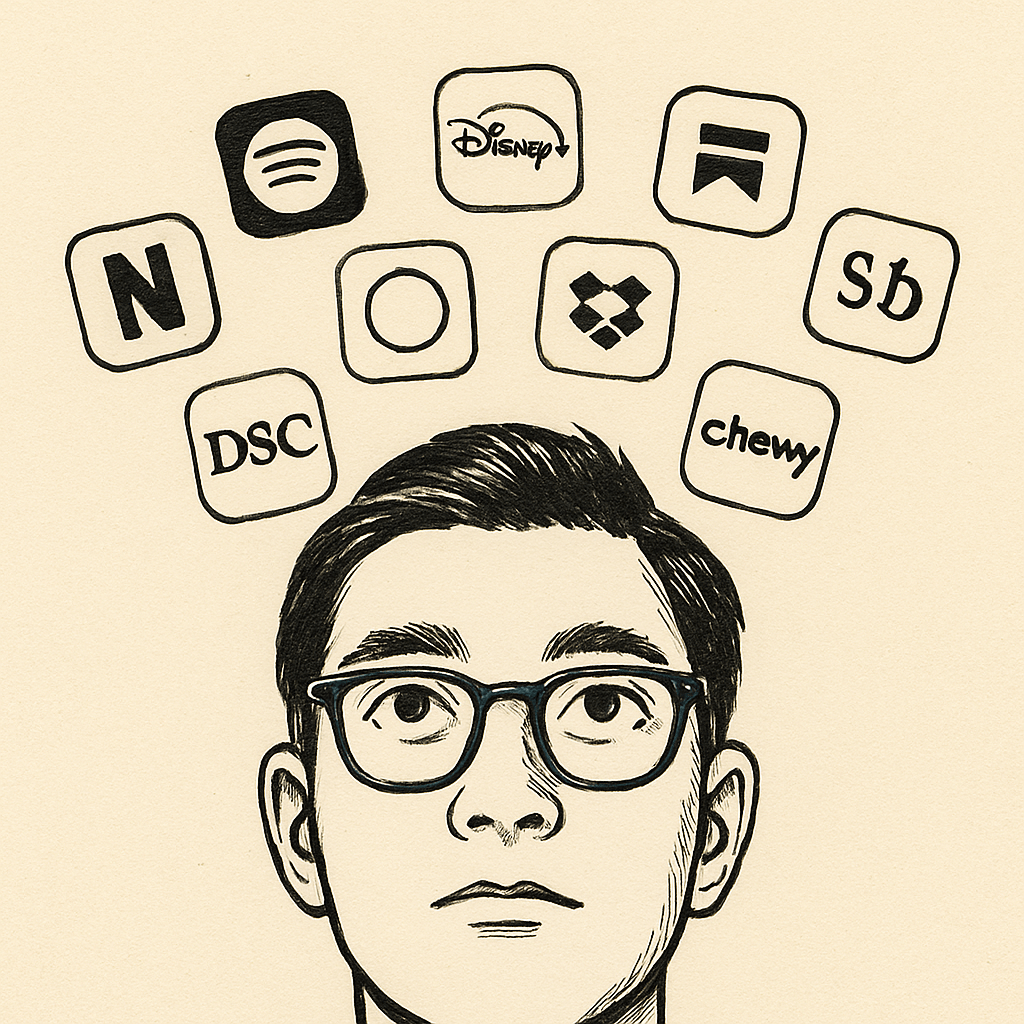
“You’re not paying for stuff. You’re paying to not think.”
That’s what Ella tells herself every morning as she laces up her Allbirds, hits her Peloton app, and queues up a Daily Calm. She lives alone now in a rent-controlled apartment in Brooklyn—once a riot of jazz records, film negatives, and cookbooks. She grew up in the ‘90s, when HBO still mailed out DVDs and newspapers blackened your fingertips. She remembers that world.
Now she’s subscribed to more things than she owns.
Netflix, yes. But also:
- Car insurance via Root.
- Skincare via Curology.
- Blue Apron for Tuesday dinners.
- A subscription for live jazz via Nublu Sessions.
- Oh, and a therapist she pays monthly, even when she skips half the sessions.
Somewhere across the world in Mumbai, Vikram—28, UX designer, crypto hobbyist, Hinge romantic—is no better.
He pays monthly for:
- Notion (work).
- Headspace (mind).
- Hinge (hope).
- Cult.Fit (abs he doesn’t have).
- Turtlemint insurance (because car crashes are real).
- Cred for credit card rewards he forgets to use.
- A Spotify subscription his ex still uses.
- A members-only NFT art collective called Swatcha Haus.
Two different cities. Two different eras. Same quiet addiction to convenience on tap.
Welcome to the subscription life.
So, What Is a Subscription Model?
At its core, a subscription model means you pay regularly to access something over time, instead of buying it outright.
But it’s more than a billing format. It’s a psychological contract:
“You show up, we’ll show up—again and again.”
It’s designed to embed a product into your life so deeply that leaving feels like self-harm.
The Anatomy of a Subscription Model
Like all great addictions, this model has structure. Here’s the first-principles breakdown:
| Layer | Description | What It Looks Like |
|---|---|---|
| 1. Hook | Initial value or emotional appeal | “Try free for 30 days”, “Unlock Pro” |
| 2. Entry Point | How easy it is to start | 1-click signup, no commitment |
| 3. Value Loop | Ongoing benefit that justifies the fee | Weekly playlists, daily meditations, fresh meal kits |
| 4. Retention Triggers | Stickiness baked in | Habit tracking, streaks, auto-renewals |
| 5. Tiering or Tokens | Multiple access levels | Freemium, credit systems, usage-based pricing |
| 6. Exit Friction | Barriers to cancellation or loss of value | Data loss, fear of missing out, re-onboarding effort |
| 7. Feedback Loop | Data used to personalize and refine | “Because you watched…” or “We noticed you liked…” |
Why Subscription Models Are Winning (IKYK)
Here’s the thing: subscriptions are sticky, and that’s exactly what makes them powerful.
- Predictable revenue: Good for business forecasting.
- Habit formation: Good for engagement.
- Low upfront cost: Good for conversion.
- Continuous data flow: Good for personalization.
Between 2012–2023, the Subscription Economy grew 435%, outpacing the S&P 500 by 6X.
A 2021 research study by Whistl found that 81% of UK households had signed-up to a subscription service, up from 65% a year before.
From Loyalty to Stickiness
In the ‘90s, Ella had a loyalty card from the corner video store. Rent 10 tapes, get the 11th free. That was loyalty.
Now? Loyalty is dead.Vikram can switch to any app, any service, anytime. What matters now is stickiness.
Product stickiness =
- It’s useful.
- It’s integrated.
- It’s a pain in the ass to leave.
Spotify? Sticky.
Apple ecosystem? Sticky like molasses in August.
That finance dashboard that knows your entire adult history? So sticky you forget your bank’s name.
Modern product builders don’t aim for loyalty. They engineer stickiness.
How Subscription Models Vary by Industry
Let’s look at how different sectors shape the model:
| Sector | Subscription Tactic | Examples |
|---|---|---|
| Media & Streaming | Flat-rate unlimited content | Netflix, Disney+, Substack |
| SaaS | Freemium → Pro tiers, usage-based | Notion, Figma, Adobe |
| eCommerce & Retail | Curation, replenishment, perks | HelloFresh, Dollar Shave Club |
| Insurance | Micro-premiums, usage-based, bundle offers | Root, Turtlemint, Lemonade |
| Finance | Premium services (e.g. FX, cashback), robo-advice | Revolut, Plum, Cred |
| Healthcare | Telehealth, mental wellness, preventive plans | Headspace, BetterHelp, One Medical |
| Art & Culture | Access to digital collections, community, events | Patreon, Nublu Sessions, Swatcha Haus |
| Fashion | Rent-the-runway, exclusive drops, sustainable wardrobes | Rent the Runway, Stitch Fix, Seasons |
| Food & Beverage | Coffee subscriptions, meal kits, pantry curation | Pret, Blue Apron, Atlas Coffee Club |
| Fitness & Wellness | Virtual training, mindfulness, hardware+content | Peloton, WHOOP, Cult.Fit |
Ella gets her art fix from a digital MoMA subscription. Vikram gets his dopamine fix from a yoga app that tracks his spine alignment.
Different strokes. Same model.
10 Subscription Models to Learn and Steal
| No. | Model | Description | Great For | Example |
|---|---|---|---|---|
| 1 | Freemium | Free entry, pay for power features | SaaS, tools, media | Notion, Spotify |
| 2 | Flat-Rate Access | All-you-can-use for one fee | Content, wellness | Netflix, Headspace |
| 3 | Tiered Plans | Price/feature gradation | SaaS, insurance | Zoom, Adobe |
| 4 | Pay-As-You-Go | Usage-based pricing | Cloud, APIs, insurance | AWS, Twilio |
| 5 | Curation Box | Regular deliveries, often themed | Retail, food, grooming | Birchbox, Scentbird |
| 6 | Token/Credit System | Monthly tokens/credits to redeem | Education, entertainment | Audible, Skillshare |
| 7 | Community + Access | Adds belonging to content | Creators, niche clubs | Patreon, Circle |
| 8 | Data-Driven Personalization | Hyper-personal offers per user | Wellness, finance | WHOOP, Plum |
| 9 | Hardware + Content | Devices with ongoing experience | Fitness, healthcare | Peloton, Mirror |
| 10 | Flexi-Use Bundles | Modular subscriptions, user chooses what to include | Telecom, finance, fashion | Airtel Black, Revolut Metal |
Whether you’re designing a subscription, tearing one down, or living under its spell, ask:
- What’s the value loop for my user?
- How embedded is this into their daily life?
- What’s our retention mechanism?
- What does quitting feel like?
Ella once said she’d cancel Netflix and finally read Proust.
Vikram swore he’d delete Bumble after New Year’s.
They’re still paying. And maybe so are you.
That’s the point.
 Amogh's Field Manual